In today’s data-driven economy, organizations generate enormous volumes of information from sales, marketing, finance, operations, customer service, and supply chain activities. However, data alone does not create value. The real competitive advantage comes from transforming raw information into actionable insights that guide strategic decisions.
This is where business intelligence software for enterprise decision making becomes essential.
Business Intelligence (BI) software enables organizations to collect, integrate, analyze, and visualize data from multiple sources. Enterprise leaders can monitor performance, identify trends, forecast outcomes, and make informed decisions faster than ever before.
As digital transformation accelerates, enterprise BI platforms have evolved from simple reporting tools into sophisticated analytics ecosystems powered by artificial intelligence, machine learning, predictive analytics, and real-time data processing.
This comprehensive guide explores everything organizations need to know about business intelligence software, including key features, benefits, implementation strategies, challenges, and future trends.
What Is Business Intelligence Software?
Business Intelligence software is a technology platform designed to gather, process, analyze, and present business data in meaningful ways.
The primary purpose is to help organizations:
- Make data-driven decisions
- Improve operational efficiency
- Increase profitability
- Identify market opportunities
- Reduce risks
- Enhance forecasting accuracy
BI software transforms complex datasets into:
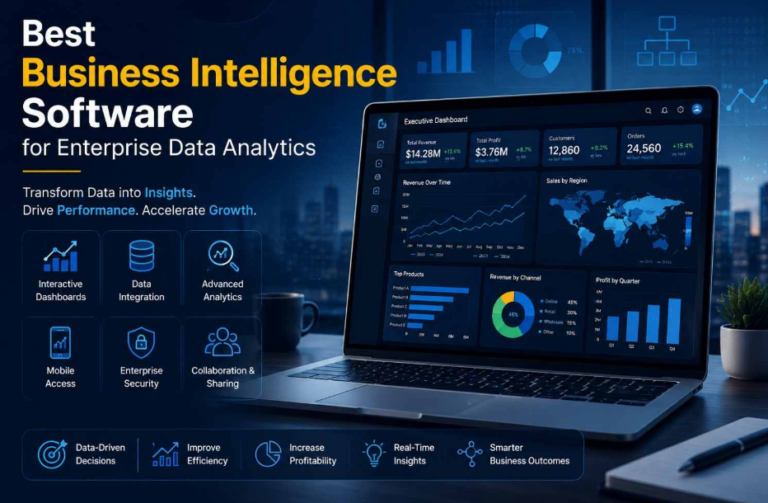
- Interactive dashboards
- Reports
- Charts
- Visual analytics
- Predictive models
- KPI scorecards
Instead of relying on intuition, managers and executives can leverage factual insights to guide business strategy.
Why Enterprise Decision Making Requires BI Software
Modern enterprises face several challenges:
Massive Data Volumes
Organizations collect information from:
- CRM systems
- ERP platforms
- Marketing tools
- Financial software
- E-commerce platforms
- IoT devices
- Customer support systems
Without a centralized analytics solution, valuable insights remain hidden.
Faster Decision Cycles
Markets evolve rapidly.
Executives must make strategic decisions regarding:
- Pricing
- Inventory
- Expansion
- Hiring
- Customer acquisition
- Product development
BI platforms provide real-time visibility to support faster responses.
Competitive Advantage
Companies using advanced analytics often outperform competitors because they:
- Understand customer behavior better
- Predict market changes
- Optimize operational costs
- Identify growth opportunities sooner

Key Components of Enterprise BI Software
Data Integration
Enterprise BI platforms connect multiple data sources into a unified environment.
Common integrations include:
- Databases
- Cloud applications
- ERP systems
- CRM platforms
- APIs
- Data warehouses
This creates a single source of truth.
Data Warehousing
A data warehouse stores structured information from multiple systems.
Benefits include:
- Improved performance
- Historical analysis
- Centralized reporting
- Consistent metrics
Data Visualization
Visualization helps stakeholders quickly understand complex information.
Popular visualization formats:
- Bar charts
- Pie charts
- Heat maps
- Geographic maps
- Trend lines
- KPI dashboards
Well-designed visualizations improve decision speed dramatically.
Self-Service Analytics
Modern BI software empowers non-technical users to analyze data independently.
Benefits include:
- Reduced IT workload
- Faster reporting
- Increased business agility
- Better collaboration
Predictive Analytics
Predictive analytics uses historical data to forecast future outcomes.
Examples:
- Sales forecasting
- Demand planning
- Customer churn prediction
- Revenue forecasting
- Risk assessment
This enables proactive decision making.
Benefits of Business Intelligence Software for Enterprise Decision Making
Improved Strategic Planning
Executives gain a clear understanding of organizational performance.
Strategic planning becomes:
- More accurate
- Data-driven
- Less dependent on assumptions
Enhanced Operational Efficiency
BI tools identify inefficiencies in:
- Manufacturing
- Logistics
- Workforce management
- Procurement
- Customer service
Organizations can eliminate bottlenecks and reduce costs.
Better Customer Insights
Customer analytics reveal:
- Buying behavior
- Preferences
- Demographics
- Lifetime value
- Retention trends
Businesses can personalize experiences and increase loyalty.
Faster Reporting
Traditional reporting often requires manual spreadsheet work.
BI automation allows:
- Real-time dashboards
- Scheduled reports
- Instant updates
- Automated KPI tracking
This saves significant time.
Increased Revenue Opportunities
Data analysis helps identify:
- Cross-selling opportunities
- Upselling opportunities
- High-performing products
- Emerging markets
- Customer segments
These insights contribute directly to growth.
Essential Features to Look for in Enterprise BI Software
Interactive Dashboards
Dashboards should provide:
- Real-time updates
- Custom views
- Drill-down capabilities
- Mobile accessibility
Artificial Intelligence Integration
AI-powered analytics can:
- Detect anomalies
- Recommend actions
- Generate insights automatically
- Forecast trends
Scalability
Enterprise organizations require platforms capable of handling:
- Millions of records
- Multiple departments
- Global operations
- Growing data volumes
Security and Compliance
Important security capabilities include:
- Role-based access control
- Data encryption
- Audit logs
- Regulatory compliance
Examples include GDPR and industry-specific requirements.
Mobile Access
Executives increasingly need analytics on mobile devices.
Mobile BI enables:
- Remote monitoring
- Faster decisions
- Executive accessibility
Business Intelligence Use Cases Across Departments
Finance
Finance teams use BI for:
- Budget analysis
- Profitability reporting
- Cash flow forecasting
- Expense management
Benefits include improved financial visibility.
Sales
Sales leaders monitor:
- Revenue performance
- Pipeline health
- Conversion rates
- Territory performance
BI helps optimize sales strategies.
Marketing
Marketing teams analyze:
- Campaign ROI
- Lead generation
- Customer acquisition cost
- Attribution models
This improves marketing effectiveness.
Human Resources
HR departments leverage analytics for:
- Employee retention
- Workforce planning
- Recruitment metrics
- Performance analysis
Supply Chain Management
Supply chain analytics help organizations:
- Forecast demand
- Reduce inventory costs
- Improve logistics efficiency
- Prevent disruptions
Top Business Intelligence Platforms for Enterprises
Several leading BI platforms dominate the enterprise market.
Microsoft Power BI
Strengths:
- Affordable pricing
- Strong integration with Microsoft ecosystem
- Powerful visualization
- AI features
Ideal for organizations using Microsoft technologies.
Tableau
Strengths:
- Exceptional visual analytics
- User-friendly interface
- Advanced dashboard creation
Popular among data analysts.
Qlik Sense
Strengths:
- Associative analytics engine
- Flexible exploration
- Strong self-service capabilities
Suitable for complex enterprise environments.
SAP BusinessObjects
Strengths:
- Enterprise-scale reporting
- SAP ecosystem integration
- Robust governance
Widely used by large corporations.
IBM Cognos Analytics
Strengths:
- AI-assisted analytics
- Enterprise reporting
- Advanced governance
Strong option for regulated industries.
The Role of Artificial Intelligence in Modern BI

AI is transforming business intelligence.
Key innovations include:
Natural Language Queries
Users can ask questions such as:
- What were sales last quarter?
- Which region grew fastest?
- What products generated the highest margins?
The system returns instant insights.
Automated Insight Discovery
AI identifies:
- Hidden trends
- Correlations
- Performance anomalies
without requiring manual analysis.
Predictive Forecasting
Machine learning improves forecasts related to:
- Revenue
- Inventory
- Customer retention
- Market demand
Prescriptive Analytics
Advanced BI platforms recommend specific actions based on predicted outcomes.
This moves analytics from descriptive to actionable intelligence.
Common Challenges in BI Implementation
Data Quality Issues
Poor data quality can undermine analytics efforts.
Common problems include:
- Missing records
- Duplicate entries
- Inconsistent formats
Data governance is critical.
User Adoption
Some employees resist adopting new technologies.
Successful implementation requires:
- Training
- Executive sponsorship
- Clear communication
Integration Complexity
Large organizations often operate dozens of systems.
Connecting these systems can be technically challenging.
Cost Management
Enterprise BI investments may include:
- Software licenses
- Infrastructure
- Consulting
- Training
Organizations should evaluate total cost of ownership carefully.
Best Practices for Successful Enterprise BI Deployment
Define Clear Objectives
Start with business goals rather than technology requirements.
Examples:
- Improve forecasting accuracy
- Increase sales productivity
- Reduce operational costs
Establish Data Governance
Governance ensures:
- Consistent definitions
- Reliable reporting
- Data accuracy
- Security compliance
Prioritize Executive Dashboards
Leadership dashboards should focus on:
- Strategic KPIs
- Revenue metrics
- Profitability indicators
- Operational performance
Promote Data Literacy
Employees should understand:
- Data interpretation
- KPI definitions
- Analytics best practices
This maximizes platform value.
Measure ROI
Track measurable outcomes such as:
- Cost savings
- Revenue growth
- Productivity improvements
- Decision speed
Future Trends in Business Intelligence Software
Augmented Analytics
AI-generated insights will become standard features.
Users will receive proactive recommendations automatically.
Real-Time Decision Intelligence
Organizations increasingly require immediate responses to changing conditions.
Real-time analytics will continue expanding.
Embedded Analytics
Analytics will be integrated directly into business applications.
Users will access insights without switching platforms.
Cloud-Native BI
Cloud adoption continues growing due to:
- Scalability
- Cost efficiency
- Global accessibility
Generative AI Integration
Generative AI is expected to revolutionize analytics through:
- Automated report creation
- Insight summarization
- Conversational analytics
- Decision support recommendations
How to Choose the Right Business Intelligence Software
Consider the following factors:
Business Requirements
Identify:
- Reporting needs
- Analytics complexity
- User count
- Data volume
Budget
Evaluate:
- Subscription costs
- Infrastructure expenses
- Training requirements
Ease of Use
User-friendly platforms typically achieve higher adoption rates.
Integration Capabilities
Ensure compatibility with:
- ERP systems
- CRM platforms
- Data warehouses
- Cloud applications
Vendor Support
Strong support services improve implementation success.

Conclusion
Business intelligence software for enterprise decision making has become an essential strategic asset for organizations competing in a data-driven world. Modern BI platforms transform raw information into actionable insights that help executives improve efficiency, increase profitability, reduce risks, and accelerate growth.
As artificial intelligence, predictive analytics, and real-time data processing continue to evolve, enterprise BI solutions will become even more powerful. Organizations that invest in robust analytics capabilities today position themselves to make smarter decisions, adapt faster to market changes, and maintain a sustainable competitive advantage.
Whether your enterprise is evaluating its first BI platform or upgrading an existing analytics ecosystem, selecting the right solution and implementing it strategically can deliver substantial long-term value.